Justitia, Old Bridge of Heidelberg

Justitia, Old Bridge of Heidelberg
Justitia, Old Bridge of Heidelberg © Gernot Keller, 2007
Blinkered Justice articles also appear on CrimeTalk and Government In The Lab
Showing posts with label crime. Show all posts

Friday, 8 June 2012

The honest politician's guide to crime control

(c) Criminonymous
To lead us gently into the weekend, here is another offering from Criminonymous. 


The truth is that almost all adults have, at some time in their lives
Committed criminal acts
And it is those who have not who are abnormal
Almost all the acts which are defined as criminal in our society
Have at some time in some society been tolerated
And even socially approved
The line between legitimate and illegitimate means of acquiring property
Is both arbitrary and difficult to define precisely
There are wide differences between states
In regard to what sexual behaviour is criminal
And considerable variation in the same state
At different historical periods
There is no evidence
That the bulk of criminal behaviour
Is the result of some pathological, mental or somatic condition
Which distinguishes criminals in general
From non-criminals

Wednesday, 9 May 2012

Bad person


(c) Criminonymous

In this latest piece, Criminonymous posits that any definition of 'crime' is contingent upon time and place. None of us are wholly innocent. Does imprisonment, and its associated sanctions, work?

There are people who break into other people’s homes
People who trespass on private land because they want to roam
A drunken person might steal a phone and a garden gnome
And then there’s couples whose love is a crime and a sin
People whose political views are deemed worthy of prison
People who transgress to achieve an end they were taught was legitimate
What you consider deviant depends on what you see as normal
What you see as bad depends on your experience of sorrow
The norms we adhere to shift like the continents
Our priorities change, but no one keeps on top of it
We all want safety, irrespective of our stance
But the people in the jails are mostly there by chance
We don’t fight crime; we define crime
We respond when we can, but for the majority of offences
There’s no such thing as a plan
That can effectively stem all the illicit demand
We blame cops too for the culture in which they live
Like with any gang culture, recruits may be of a certain creed
But to reintegrate, our forgiveness is what they need
Police are as manipulated as everyone else
All mental health is suspect in and of itself
People are fragile
Liable to influence by their surroundings, like the hopeless in prison
The futile stockpiling of our brothers and sisters
And when they’re out, these erstwhile exiles
No longer fit the profile of a worthwhile punt
They must be imbeciles; their values must be totally different
Can’t reconcile employment with debilitating criminal illness
Forgetting that crimes are committed by almost all of us
What if everyone was charged the first time they tried drugs?
Everyone who shoplifted, downloaded a song, sped or littered?
Caught or not, it’s the overwhelming majority
That’s the sheer insanity of the us-and-them mentality
Our primal hostility masked as higher morality
Assumptions of purity are no more than an illusion
We prescribe division like our laws were the words of a god
And to break them is to trash our religion
But if you put everyone corrupt in jail, who will be left to lock us all in?
It’s a war of attrition that we’re never going to win

(c) Criminonymous

Friday, 3 February 2012

A poetic social construction of crime


Oscar Wilde and his lover, Alfred Douglas,
prior to his trial in 1894

As we each slink off to our weekends, I am publishing the poem below, written by Criminonymous. You can find another piece here, published on Anna Raccoon a few days ago.  No need for me to add any more; the strength of the piece speaks for itself. 

The only thing we have to blame is blame itself

I fail to see what we gain from blaming the individual
The working class criminal whose education was minimal
Some see their behaviour as indefensible
That the casual accrual of wealth through unconventional or deviant methods
Demeans the tax-paying, hard-working and indebted

If it were only explained more clearly in schools
That it’s just a few tools
Who monopolise the making and enforcement of rules
Why do we assume that the criminal law is the best way to respond to these issues?
Crime is a social construction
Should homosexuality be a crime?
Obviously, obviously not
But some countries still consider it as such
Do you think that alcohol should be criminalised?
These things vary over space and time
It is wrong to assume that the laws as they stand
Are based on rational calculations
Nor should it be assumed
That the direction in which the criminal law is currently headed
Is necessarily in the long-term interests of society as a whole

Some people see ‘criminals’ as totally different to them
When they think about crime
They remember what they have seen in the media
They immediately think about the most heinous of transgressions
But this is only a tiny fraction of what ‘crime’ really entails
Incidentally, many of these people are swing voters
The central focus of modern-day locusts
But when elections are based on fear
There is no incentive to ensure that our electorate is educated
And this lack of knowledge is perpetuated

In reality, all are equally likely to be caught up in something this forlorn
Because you have no control over where or when you are born
Some people truly believe that they had immunity
Thinking: “They are not us, so they deserve no impunity”
But we were all born in the same world, without equality of opportunity
Substitute assumed fallacies for humanity
It’s safe to say that we’re pretty lucky
I could have been born in Kentucky
Home to sixteen of the one hundred poorest counties in that country
Equally, the Queen is lucky not to be an Armenian from 1915
Got any pre-teens?
Elsewhere they make green jeans for the armies
Like Akala said, as hard as some of us have it
We’re still far better off than ninety per-cent of the planet

It is totally understandable that in this environment of propaganda
People make false assumptions about crime and justice
We don’t get to decide what counts as a crime
When the law should change its mind
Or where our priorities should lie
Nor are these decisions made well for us
So forget your anxiety regarding impropriety
And consider the long-term interests of our society

Criminonymous

Friday, 16 December 2011

Margaret Moran & the face of crime

Margaret Moran MP (c) Richard Lea Hair

Yesterday, The Guardian reported that former Labour M.P. Margaret Moran, accused of falsely claiming £80,000 in expenses, and her legal team would be making an application for a “nolle” to the attorney general. This would allow the case against her to be discontinued on exceptional grounds.

If granted, Moran would not stand trial. Instead, a jury would assess the merits of the case in her absence at a trial of issue. Jim Sturman, her Q.C., stated:
"These proceedings are a continual threat to her life, not just to her liberty, and the experts agree that she is unfit to plead."
Three pyschiatric experts have evaluated Moran and all come to the conclusion that she is unfit to plead. Sturman himself talks of his only meeting with Moran, in which she cried during the whole conference, and refers to a previous hearing at Westminster magistrates court, in which she sobbed uncontrollably in the dock.

I understand that it is considered more beneficial for defendants to attend their trial so that they can defend themselves more adequately. However, with the team that she has on board, the public display of her illness, and people's general disdain for M.P.'s expenses abuse, I wondered whether her absence would harm her case.

If not, do others with less (financial/political?) clout have access to the same recourse?

Kelly (2000), amongst others, has conducted research into links between inequality and crime. The Ministry of Justice report on the UK riots reveal the depth of the links between social exclusion, inequality, poverty and transgressions of the law.
  • 35% of adult rioters were claiming out of work benefit, almost three times the national average (12%)
  • 64% of child rioters lived in the country's most social excluded areas
  • 66% of child rioters were classified as having special education needs, again three times the national average (22%)

Social exclusion, inequality and poverty are also linked to mental health problems. Therefore, if we accept that the majority of those passing through our criminal justice system are from poorer socio-economic backgrounds, then we also have to accept that many will pass through the system with similar issues to those of Margaret Moran.

Moran is using a Q.C. Q.C.s cost a lot more than less qualified barristers. By using a more prominent, and presumably, more knowledgeable barrister, this will have enabled Moran to pursue this course of action.

Furthermore, Moran was examined by three psychiatrists over a period of two years. Again, this will have cost a lot of money. All this will be quite different to the legal (aid?) access that those living in poverty will have recourse to.

Looted Sainsburys local, Chalk Farm (c) hughepaul
Looking back at Sturman's statement regarding his client, it is difficult to find any reason why Moran should receive better treatment than the children who have been criminalised as a result of their wrongdoings during the summer riots. There is a large gulf between the alleged crimes of Moran and child rioters.

Not only will these children have had emotional needs, not dissimilar to Moran's, but arguably this is a greater threat to their life, because their criminalisation threatens their life chances; unemployment, poorer physical health, further mental health problems, and an earlier death.

Due to her influence, Moran will be able to distance, and anonymise herself, by her absence at her trial, yet children have lost their right to anonymity in the UK criminal justice system. Those in power want us to remember who 'criminals' are, regardless of their age and the protection that we should afford them.

I am minded of Reiman's 'pyrrhic defeat theory'. This maintains that the way in which the criminal justice system, and criminal justice policy, works is to perpetuate the myth that 'criminal activities' are solely associated 'with the dangerous acts of the poor' (Reiman, 1998).

In other words, a burgeoning prison population, peopled by those from poorer socio-economic backgrounds, is a loss leader for governments, because it diverts the public's attention away from crimes committed by the powerful.

This case is just another example of what the face of crime looks like. 

Sunday, 30 October 2011

Confused homosexualities? Tsvangirai, Zimbabwe and the UK

(c) Nick Clegg
Republished in full from The Pryer.

In Africa, homosexuality is often talked about, and identified, as being un-African. The other day, Morgan Tsvangirai claimed that he would support the inclusion of gay rights in the new Zimbabwean constitution. The Herald quotes Tsvangirai thus:
 “It’s a very controversial subject in my part of the world. “My attitude is that I hope the constitution will come out with freedom of sexual orientation, for as long as it does not interfere with anybody,” he told the BBC. “To me, it’s a human right,” he added.
Yet this alleged support for gay rights appears contrived. First off, this represents a u-turn for Tsvangirai who has previously supported Mugabe’s staunchly hostile stance on homosexuality. Tsvangirai has a history of changes of heart, including on recent policy proposals for indigenisation and a negotiated constitution.

More telling is a press conference held just two days later. When questioned on his defence of gay rights, Radio Vop Zimbabwe reports:
Tsvangirai drew wild laughter from the house when he suggested, “perhaps I am speaking here kuda mumwe musi mungangodai muringochani panapa (we may be talking while some of you may be gays here). What you do in your private sphere is your private problem.”
By mocking “gays” and their “problems”, he seems to be drawing on cultural 'attitudinal' norms to re-establish his credibility through the national media. These are not the words of someone overtly in support of gay rights. Interestingly, his website contains no news on his recent pronouncements. Given his propensity to about face, I doubt that this will be Tsvangirai’s final opinion on gay rights.

Lest I castigate Tsvangirai too harshly, let us look at the UK’s role in current homosexual discourse in Zimbabwe. In his piece in New Zimbabwe, Dr. Munya Munochiveyi traces the history of homosexuality from the practices of ancient tribes of Africa, through to the rituals of warrior societies of Zimbabwe, to the colonialism of the Victorians and Rhodesia. He posits that homosexuality is not un-African, and that it only became a cultural taboo, and norm, as a result of British colonial rule. Of course, the paradox of this is that the anti-colonial, anti-British Robert Mugabe espouses the same homophobic attitude as the colonials he despised.

File:Flyingrainbowflag.JPG
(c) theodoranian
Coincidentally, The Independent claims that Foreign and Commonwealth Office (FCO) has instructed its Ambassadors not to fly the ‘gay flag’ as “it opens up too many potentially difficult and divisive questions”. This follows praise that three British Ambassadors had received from local gay communities for doing just that in support of local gay pride marches. 

One of the FCO’s stated priorities is to:
Strengthen the Commonwealth as a focus for promoting democratic values, human rights, climate resilient development, conflict prevention and trade
On a week when Stuart Walker was allegedly killed for being gay, and when it was reported that there has been an increase in homophobic hate crimes in the UK, the above does not strengthen the UK's human rights position.

Returning to Munochiveyi’s article in New Zimbabwe, it is noteworthy that the accompanying photograph features two white women; the press still seem uncomfortable with ideas of being African and homosexuality. Looking through the comments following the article, it appears that Zimbabwe has some way to go before it will accept homosexuality as being normal. 

The evangelical posturing of our colonial ancestors has left human rights scars all over Africa, and this is a further example of it. As much as we would like to see a change in African attitudes, they would like to see a change in ours.  


Wednesday, 10 August 2011

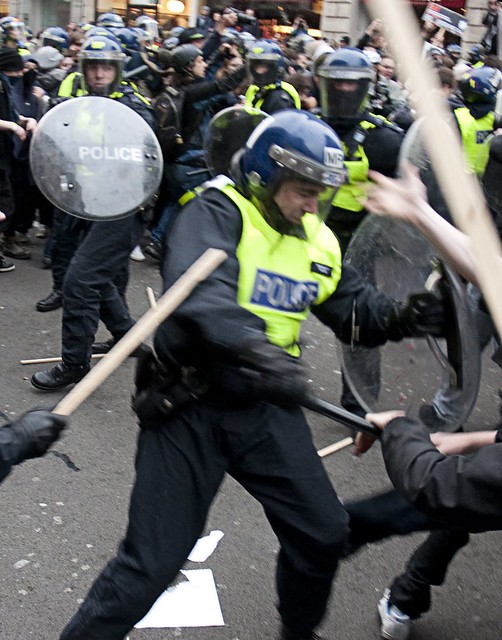
Policing the UK riots?

(c) William 79
Earlier this evening I tweeted


16,000 police being deployed in London tonight to quell #UKriots. Why not last night or night before? Police making a point about govt cuts?

Given that only 6,000 police were on the streets the night before, one has to wonder why has there suddenly been a sudden 267%  increase on the number of police being deployed tonight.

Last night was night 3 of the disturbances. Whilst the major politicians were away on holiday, only returning to the UK today to address the situation, there were still people present, whom I am sure it is in their job description, that are supposed to step up and deal with situations like this. Tonight, the 16,000 strong police force appear to have extinguished the ardour of those seeking to set fire and loot. At what point, did those left to deal with the disturbances not think that it might be worthwhile having a more visible police presence on the street the last couple of nights?

One has to wonder whether the police were sending out a message to the public and the government. We know that recent government cuts are due to hit police forces all over the country over the next few months. We know that they claim that this is going to put the public at greater risk. Yet those in charge of police operations in London over the last couple of evenings have blatantly failed to safeguard the public. Nobody has come forward to explain why more police were not deployed earlier to protect the public.

For me, it seems that the police have only taken full ownership of the problem tonight. There does not appear to be a good reason why they did not so before, unless they had ulterior motives. 

UK riots: who is responsible?

2011 Tottenham riots on High Road (c) Victoria

Copycats, mindless thugs and disenfranchised youth are all terms that have been used to describe those who have taken part in the disturbances over the last few nights. But do any of these descriptions explain what, or, why it is taking place?

We know that the first riot that took place in Tottenham started largely as a result of the killing of Mark Duggan. However, this soon mutated from anger at the reaction of the police and IPCC, to one which focussed on looting local businesses. Looting seems to have been the primary objective for those rioting. It has been reported at any number of sites throughout London, and has since spread across Birmingham, Liverpool and Manchester, amongst other areas.  

One might see these rioters simply as copycats.  I am presuming that this term has been widely used in the media to denigrate those taking part in the riots, and to make them think that their actions are not as good as those that did it originally. However, this misses the point. They are not necessarily looting to look as “good” or as “hard” as their forebears. From Blackberry messages that have been made public (see Newsnight link), they appear to be looting to make some money. Is this the work of mindless thugs?

No. Everyone wants to make money.  This is exactly what the capitalist society is about, but some people are less able to make money in this socially divided society in which we live. This is as ideological as it is economical. 

At the same time, people see politicians, the police, bankers and multinational corporations loot the public purse to line their own. And whilst I agree that this is not an excuse to start rioting/looting, one has to consider whether this kind of “criminal” behaviour has a knock-on effect, given that we still live in a largely hierarchical society.

Tonight’s Newsnight has suggested that amongst those arrested for rioting/looting, are people from the traditional middle class backgrounds. Please check on the BBC iPlayer tomorrow for evidence of this report. If so, this hints at something more than the disenfranchised youth who live on council estates as being responsible for the riots.

For the purposes of this blog, I do not condone any of the actions taken by the rioters/looters over the past four nights. The riots are especially distressing for those that have been left frightened, and for those that have lost their livelihoods and property. I thoroughly understand their frustrations (please see my next post on this).

Whilst these actions are not justifiable, we need to understand why people are rioting/looting. We need to talk to them and we need to understand what it is they are saying on a personal and cultural level, so that we can try to avoid future disturbances.

My fear is that this is only going to lead to more punitive measures that target specific communities, and that it provides the coalition government with an excuse to make cuts in welfare services that negatively affect those self same people. This will not address the problems that we have in our society, namely that greed is good, but will serve to divide society more by stereotyping, and further excluding, those who are already marginalised by consumerism. 
Enhanced by Zemanta

Wednesday, 13 July 2011

Phone-hacking saga: public and private lives

(c) World Economic Forum/Photo by Andy Mettler 

Following further claims the other day of the dubious practices employed by News International, this article is going to focus on ideas of the public and private and what it means in terms of the ongoing phone-hacking furore.

The recent revelations of the hacking of the Dowler family’s mobile phones have rightly led to widespread revulsion. Their otherwise private world, only subject to media interest due to tragedy, has sparked wider press and public attention.

The phone-hacking scandal has been running since early 2006, when Prince William and some of his aides and contacts suspected that their phone messages had been intercepted. Clive Goodman, the then Royal Editor of the News of the World, subsequently reported on the Prince’s knee injury and his plans to edit his gap-year videos and DVDs together to make a home movie. Riveting. Since then, we know that there have been approximately 4000 victims of phone hacking, including celebrities, politicians, sportsmen, and members of the public.

As this story has only recently erupted because of the Dowler family’s involvement, this calls into question at what point we, the British public, think that it’s reasonable to intrude into the private lives of those in the public eye. Do they have a right to a private life? Are any details of the private lives of the rich and famous in the public interest? Or is it merely that the public is interested in the lives of the rich and famous?

 "This story is so old and boring. Where does it take anybody? Newspapers will seek out information from whatever sources they can, until newspapers close down. I don't think it does us any damage. It's a bit of a non-story."


(c) Gene Hunt
The above quotation, comes from a Scotland Yard source in response to a story in The Guardian in September last year. This suggests that although the act of phone-hacking is in itself illegal, that institutionally, The Met considers it quasi-illegal and only one of a number of questionable ways that the press go about their business. For instance, many celebrities complain of being “papped”. When being “papped”, they may be in a public space, or sometimes not, but either way they are denied a right to privacy in return for a “story”. Should this be legal?

Over the last couple of decades or so, we have witnessed the dramatic growth of celebrity culture.  From the likes of Hello and OK magazines to reality TV programmes such as Big Brother, we have consumed ideas of celebrity and begat more celebrities. Our desire for celebrity has seen a blurring between the private and the public. Public, famous people have let us into their houses to gawp at their personal wedding photos and private, less famous people have allowed us to watch them shower and go to bed in public. 

The printed press, who are in the business of selling newspapers, have reacted to this ever-growing demand. Take a look at the online front pages of today’s popular newspapers including The SunThe Mirror and Daily Mail, and in amongst some news, you will still find all you might desire on the latest celebrity stories. With celebrity culture as it is, the printed press have embarked on maximising their profits by using and abusing it. The press will do whatever they can to get a "story” and do not care who gets in the way.

By engaging in these activities, we have contributed to an insatiable demand for stories relating to the public and private lives of those who appear in the news. And this is where we, the British public, are accountable. We have led the media to believe that this is all that we are interested in. Like the relationship between a dealer and addict, they believe that we crave as much information on the private lives of those in the news, knowing that we will happily gorge on it and come back for more. In our droves, we buy the newspapers and magazines that contain these "stories" and we watch the TV programmes that create more interest in celebrity. In conjunction with the media, we have constructed modern celebrity culture and created the climate for suspect media practices to exist.

I am not saying that we should not be interested in the lives of celebrities, sports people, film and TV stars, or politicians. On certain occasions, intruding into the private lives of public figures is in the public interest (e.g. David Cameron’s dinner parties with senior News International executives). However, regardless of the arguments over whether celebrities use the press or not to further their own interests, we have the power to decide whether to buy into it. Put simply, we can shut the media up by not buying their particular paper or magazine and not watching particular TV programmes. We can further change this, so that we do not unwittingly harm the lives of those who have been caught in the public glare. I shall be launching a Facebook campaign, asking those of you who follow me there, on this blog, or on Twitter, to impose a celebrity “fast” on yourselves. Further details will follow.

Due to the indistinct borders between the public and private, and spiralling celebrity culture, we seem to find it hard to gauge exactly what it is that we should know about the private lives of families and individuals. Consequently, in our quest to know all we can of those in the news, the media do all that they can to provide us with that information, and people get hurt. It is not just the media, the organisations that own them or The Met that are culpable for recent events. It is us too.   
Enhanced by Zemanta

Wednesday, 1 June 2011

Throw away the key: serial offending in the UK


The following article has been republished in full from The Pryer as the original has been archived on an old server and is no longer available. This article was originally published in June 2011. 


(c) Lionel Allorge

The Telegraph published an article yesterday, claiming that serial offenders are far less likely to be jailed than they were a decade ago. Other newspapers, including The Daily Express, have also been berating a criminal justice system, that they claim is soft and operating a revolving door policy.


I have downloaded the latest Ministry of Justice bulletin. Pages 68-69 contain the following information on offending histories:

Just over half of offenders who committed indictable offences and were cautioned in 2010 had no previous criminal history, although 3% had 15 or more previous cautions/convictions:
  • 54.1% of offenders of all ages who received a reprimand, warning or caution for an indictable offence in 2010 had no previous offences;
  • 3.2% of offenders had received a reprimand, warning, caution or conviction on 15 or more previous occasions. The majority of these offenders received a reprimand, warning or caution for drug offences and theft and handling stolen goods offences; 
  • The equivalent figures for the year 2000 show that the criminal history profile of cautioned offenders is changing over time: 67.3% had no previous offences while 1.3% had 15 or more previous occasions.
The criminal history profile of sentenced offenders is also changing over time. More offenders sentenced for indictable offences in 2010 had previous offences, and a higher proportion of offenders had 15 or more previous convictions or cautions:
  • the proportion of all offenders sentenced for indictable offences who had 15 or more previous convictions or cautions has increased steadily from 16.8% in 2000 to 28.9% in 2010; 
  • Over the same period the proportion of sentences given to offenders with no previous convictions or cautions fell from 12.3% to 10.5%. 
The criminal history of offenders receiving different sentences varies by sentence, with custodial sentences associated with higher levels of previous offences, in 2010:
  • 43% of adult offenders receiving custodial sentences have 15 or more previous convictions/cautions.
  • 27% of adult offenders receiving a fine have 15 or more previous convictions/cautions
A-Block at Alcatraz (c) Nonie
In his column, Tom Whitehead repeatedly refers to “hardened offenders” as those being cautioned or avoiding custody. I understand the need to sell papers and online advertising, but the sensationalist use of “hardened offenders” is somewhat different to the offenders identified above. Moreover, the report indicates that serial offenders are getting their ‘just desserts’ and only a minority are getting away with it. The article is clearly geared towards a more punitive idea of justice. Yet punitive measures, such as imprisonment, are clearly not working if criminals re-offend. Fifteen or more times.
Based at Kings College, the Centre for Crime and Justice Studies estimate that the annual cost of keeping someone imprisoned is £38,000.There have been several studies conducted on public opinion and sentencing policy. Many indicate that the public are less inclined to seek a custodial sentence when other factors are known.
Roberts and Hough (2011) have recently published an article that explores under what circumstances the British public would opt for an alternative community penalty over imprisonment as punishment. They found that many respondents considered community punishment sufficient, even for relatively serious offences. Along with knowing the financial costs of a custodial sentence, consideration of an individual's circumstances and a thorough understanding of the non-custodial option were determining factors that altered these participants’ perceptions of sentencing.

The Conservative government are right to look anew at sentencing. However, they need to balance a whole range of issues that take into account the rights of the victim(s) and their families, and the rights and circumstances of the accused.