Justitia, Old Bridge of Heidelberg

Justitia, Old Bridge of Heidelberg
Justitia, Old Bridge of Heidelberg © Gernot Keller, 2007
Blinkered Justice articles also appear on CrimeTalk and Government In The Lab
Showing posts with label social construction. Show all posts

Friday, 8 June 2012

The honest politician's guide to crime control

(c) Criminonymous
To lead us gently into the weekend, here is another offering from Criminonymous. 


The truth is that almost all adults have, at some time in their lives
Committed criminal acts
And it is those who have not who are abnormal
Almost all the acts which are defined as criminal in our society
Have at some time in some society been tolerated
And even socially approved
The line between legitimate and illegitimate means of acquiring property
Is both arbitrary and difficult to define precisely
There are wide differences between states
In regard to what sexual behaviour is criminal
And considerable variation in the same state
At different historical periods
There is no evidence
That the bulk of criminal behaviour
Is the result of some pathological, mental or somatic condition
Which distinguishes criminals in general
From non-criminals

Wednesday, 9 May 2012

Bad person


(c) Criminonymous

In this latest piece, Criminonymous posits that any definition of 'crime' is contingent upon time and place. None of us are wholly innocent. Does imprisonment, and its associated sanctions, work?

There are people who break into other people’s homes
People who trespass on private land because they want to roam
A drunken person might steal a phone and a garden gnome
And then there’s couples whose love is a crime and a sin
People whose political views are deemed worthy of prison
People who transgress to achieve an end they were taught was legitimate
What you consider deviant depends on what you see as normal
What you see as bad depends on your experience of sorrow
The norms we adhere to shift like the continents
Our priorities change, but no one keeps on top of it
We all want safety, irrespective of our stance
But the people in the jails are mostly there by chance
We don’t fight crime; we define crime
We respond when we can, but for the majority of offences
There’s no such thing as a plan
That can effectively stem all the illicit demand
We blame cops too for the culture in which they live
Like with any gang culture, recruits may be of a certain creed
But to reintegrate, our forgiveness is what they need
Police are as manipulated as everyone else
All mental health is suspect in and of itself
People are fragile
Liable to influence by their surroundings, like the hopeless in prison
The futile stockpiling of our brothers and sisters
And when they’re out, these erstwhile exiles
No longer fit the profile of a worthwhile punt
They must be imbeciles; their values must be totally different
Can’t reconcile employment with debilitating criminal illness
Forgetting that crimes are committed by almost all of us
What if everyone was charged the first time they tried drugs?
Everyone who shoplifted, downloaded a song, sped or littered?
Caught or not, it’s the overwhelming majority
That’s the sheer insanity of the us-and-them mentality
Our primal hostility masked as higher morality
Assumptions of purity are no more than an illusion
We prescribe division like our laws were the words of a god
And to break them is to trash our religion
But if you put everyone corrupt in jail, who will be left to lock us all in?
It’s a war of attrition that we’re never going to win

(c) Criminonymous

Wednesday, 22 February 2012

The Wednesday ? - British values of tolerance


A quick introduction into the Wednesday ?

I propose using the Wednesday ? on a trial basis over the next few weeks. The purpose of it, unlike Questioning The Headlines (which I will do again shortly), is to look at specific words and/or phrases that are used, mainly by those in power, as a means of short-cutting any criticism or independent thought.

I want to highlight these words and phrases, and promote public debate. This is where you come in. It would be fantastic if you could post your own thoughts to add to the discourse. By doing so, hopefully, we can build on a cultural understanding of these terms, and de-construct some of the (inherent?) assumptions contained within them.

“British values of tolerance”

The Telegraph reported yesterday that the coalition government would be publishing their new integration strategy for immigrants coming to make the UK their home. The article continued:
The integration strategy will state: “We believe in certain values and will actively promote them: freedom of speech; freedom of worship; democracy and the rule of law. Long-standing British values of tolerance are the bedrock of our society. We will champion a united British identity, across class, colour and creed.”
I could have added the term “long-standing”, but this will be discussed as part of my critique. Equally, I could have covered “British values” as a stand-alone subject, but I want to keep this post shorter than my other analyses, and I would like you to stay awake.

Assumptions of the “British values of tolerance”

In terms of what is being promoted, I would hazard a guess that this phrase is being used to summon up that fuzzy feeling of “being proud to be British”; we are a civilised people, who have welcomed peoples of different race, creed, and religion to the UK. It assumes that we do not just “put up with” people from different backgrounds, but that we were the first nation to promote a “tolerance” that advocates equal rights.

The idea that it is traditionally British, embeds these values with being white, middle/upper class, able-bodied, and more than likely, male.

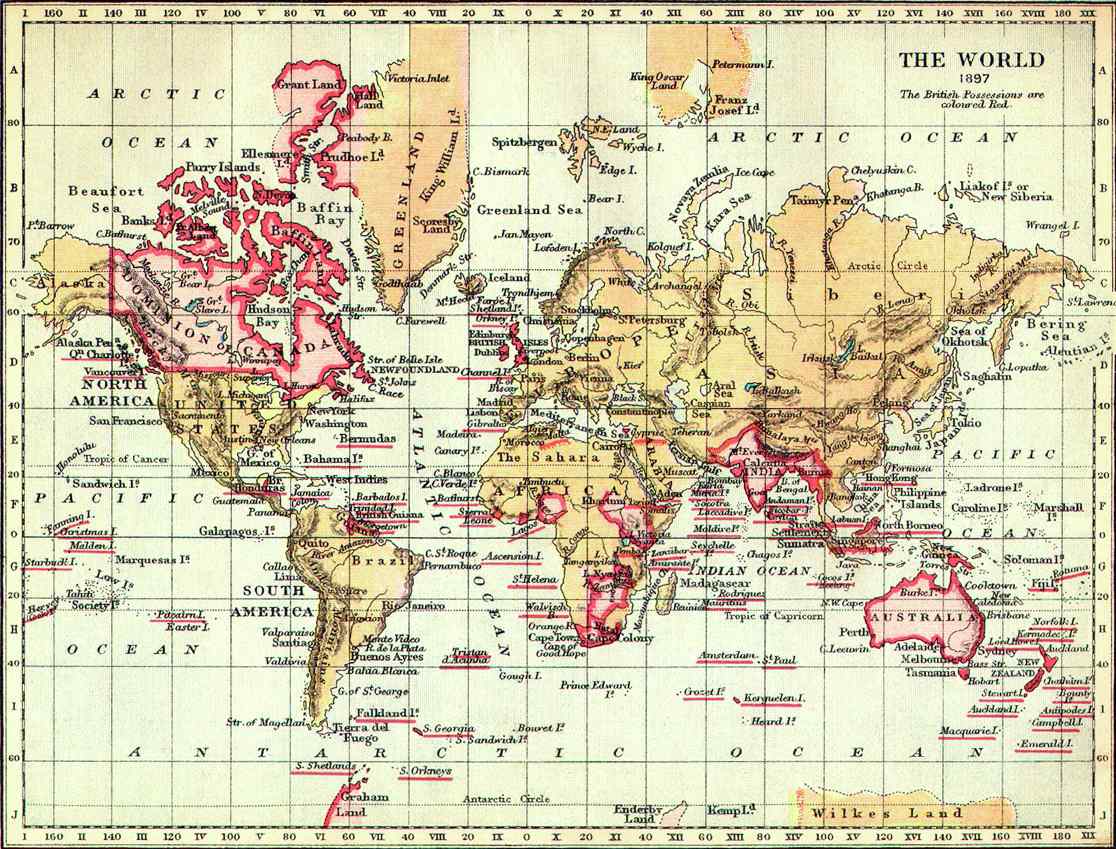
The world in 1897 - British possessions coloured red
“British values of tolerance”?

Beyond the rampant theft of resources in Africa and Asia as the British Empire extended its power, another part of its expansion was evangelical, which saw us trying to “civilise” other nations. This was not a tolerance, this was an imposition of our behaviour onto those who lived in different parts of the world.

Since the turn of the 20th Century, whilst the British have allowed peoples from other cultures to settle in the UK, it has come with ever increasing legislation and consternation.

The Aliens Act of 1905 was the first act to introduce immigration controls for the UK; it was designed to stop an increasing number of Jewish immigrants entering the UK. Ever since, the British have legislated for other people to join them as a means to fill gaps in the labour market (British Nationalist Act 1948), and then have passed acts to stop them entering the UK (Commonwealth Immigrants Act 1962) as a result of a public backlash.

Racially motivated riots over the last 60 years or so do not indicate that we live/have lived in a society that has promoted tolerance in the way that the phrase indicates. Clearly, we welcome people into the UK when it fulfils British economic needs, but that we “put up” with them living here. The notion that this British value of tolerance is “long-standing” is faulty.

Although the term implies an equality of residential rights in the UK, it rests on the idea that immigrants are/were “lucky” to have come here. It does not take into account whether people were well-educated in their country of birth, nor that they took menial work and wage in the UK, let alone whether they have been driven out of their homes because of war. Including those that Britain engages in.

There is also a denial of other nation's values of tolerance in this term. Societies around parts of Asia and Africa regularly welcome foreigners, and strangers, into their homes, and treat them as family members or long-standing friends. Why is their value of tolerance supposedly not as good as ours?

Supposedly, this integration strategy also promotes ideas of tolerance to hate groups in the UK. My fear is that this strategy only promotes the kind of toleration discussed above, and that we are pandering to an outdated idea.

After a century of official multi-cultural living in the UK, it would be interesting to know what today's “British values of tolerance” mean now. Over to you.

Friday, 3 February 2012

A poetic social construction of crime


Oscar Wilde and his lover, Alfred Douglas,
prior to his trial in 1894

As we each slink off to our weekends, I am publishing the poem below, written by Criminonymous. You can find another piece here, published on Anna Raccoon a few days ago.  No need for me to add any more; the strength of the piece speaks for itself. 

The only thing we have to blame is blame itself

I fail to see what we gain from blaming the individual
The working class criminal whose education was minimal
Some see their behaviour as indefensible
That the casual accrual of wealth through unconventional or deviant methods
Demeans the tax-paying, hard-working and indebted

If it were only explained more clearly in schools
That it’s just a few tools
Who monopolise the making and enforcement of rules
Why do we assume that the criminal law is the best way to respond to these issues?
Crime is a social construction
Should homosexuality be a crime?
Obviously, obviously not
But some countries still consider it as such
Do you think that alcohol should be criminalised?
These things vary over space and time
It is wrong to assume that the laws as they stand
Are based on rational calculations
Nor should it be assumed
That the direction in which the criminal law is currently headed
Is necessarily in the long-term interests of society as a whole

Some people see ‘criminals’ as totally different to them
When they think about crime
They remember what they have seen in the media
They immediately think about the most heinous of transgressions
But this is only a tiny fraction of what ‘crime’ really entails
Incidentally, many of these people are swing voters
The central focus of modern-day locusts
But when elections are based on fear
There is no incentive to ensure that our electorate is educated
And this lack of knowledge is perpetuated

In reality, all are equally likely to be caught up in something this forlorn
Because you have no control over where or when you are born
Some people truly believe that they had immunity
Thinking: “They are not us, so they deserve no impunity”
But we were all born in the same world, without equality of opportunity
Substitute assumed fallacies for humanity
It’s safe to say that we’re pretty lucky
I could have been born in Kentucky
Home to sixteen of the one hundred poorest counties in that country
Equally, the Queen is lucky not to be an Armenian from 1915
Got any pre-teens?
Elsewhere they make green jeans for the armies
Like Akala said, as hard as some of us have it
We’re still far better off than ninety per-cent of the planet

It is totally understandable that in this environment of propaganda
People make false assumptions about crime and justice
We don’t get to decide what counts as a crime
When the law should change its mind
Or where our priorities should lie
Nor are these decisions made well for us
So forget your anxiety regarding impropriety
And consider the long-term interests of our society

Criminonymous

Tuesday, 31 January 2012

Crime mapping : revealing problem people and problem places?


Home Secretary, Theresa May
(c) UK Home Office


Criminal activity in the Whitehall area outstripped that of the riot centres of Tottenham and Hackney in December 2011. Over twice as many violent crimes took place in Whitehall, and possession, supply and production of drugs was approximately 5 times higher there, than in either Tottenham or Hackney.

Time to get more police out to regain control of the streets of Whitehall? Will residents, institutions and businesses in the area move out? Will parents choose to move in order to send their children to school elsewhere? Will it affect property prices? Will the area become disenfranchised and run down?


Of course not. Exclusion and marginalisation is not for those who live, work and do business in this area.

Therein lies the problem with ideas of crime mapping; spatially, it relies on normative assumptions of crime to reaffirm 'problem people' and 'problem places'.

Described as “a feminist in kitten heels” by Amber Elliott, Theresa May launched the new version of the UK's crime map. According to the BBC, the Home Secretary revealed that the new website would make the police more accountable:
"Since October, the public have been able to use the police.uk website to see how their force performs in a range of areas like crime rates, quality of service and victim satisfaction," ...

"[On Tuesday] we'll launch the next stage of crime mapping, in which we'll start to map crimes to or near a range of public places. 
"By May, crime maps will show the public what happens after a crime has occurred - what action the police took and what the criminal justice outcome was." 
"Armed with the information from those crime maps, people can attend their local neighbourhood beat meeting and hold their local police to account for their performance," ... 
"That will help drive up local policing standards and help drive down local crime."
The map will now cover 'crimes' committed in public places, such as nightclubs, subways, and parks.

As the statement above illustrates, the assumption is that people will view this map as a means to ascertain what crime is like in their (prospective) neighbourhood. Therefore, people will not be using this map to assess the likelihood of 'crimes' close to where they work, thereby hiding other 'problem areas' and 'problem people'.

It also fails to address who victims might be and what recourse to help they have.

I do not know who the victims of the crimes in Whitehall are. However, in amongst their number, I am presuming that some will have been tourists, as this area contains a number of well-known tourist sites.

Tourists consulting City of London map (c) David Iliff. License: CC-BY-SA3.0
If this is a reasonable assumption to make, then it seems that crime mapping has not been produced with the millions of tourist that visit our shores in mind, despite the financial benefits that they bring. How might they attend future meetings? Who are their local police force? How might they understand what is happening with their case?

Whilst Theresa May asserts that crime mapping will drive up local policing standards and that local crimes will be driven down, it is already being used, but it does not appear to have dramatically reduced the numbers of 'crimes' committed in Whitehall between December 2010-December 2011.

Perhaps more pertinently, given that this is a critical criminology blog, is the fact that crime mapping uses normative, state-defined notions of 'crime'. There are a whole host of crimes that are not included on this map. State, corporate and environmental crimes are most obvious in their absence.

Crime mapping does not include deaths in police custody, as internal inquiries reveal that no criminal action need take place. It would not include the rendition of Libyan dissidents, because it is a civil case. Nor would it include this fraud, as it too has been investigated internally, rather than criminally. Let alone state environmental contamination.

Although these 'crimes' took places in what might also considered public places, the latest crime mapping website will exclude them as 'problem places'. In other words, we will not see local police stations or financial institutions identified as 'criminal' on this map.

Moreover, normative, state-defined 'crimes' include those UK rioters who have been criminalised following their involvement in the UK riots; ordinarily, would they have been punished (think Bullingdon club exploits)?

Some 'crimes' have dubious origins. For example, the construction of anti-social behaviour orders, and their expansion from their original, intended use, have led to the prosecution of thousands of young people.

The above demonstrates how the state, through its institutions such as the criminal justice system, has the power to define and reconstruct what 'crime' is. By mapping the city through these definitions, certain places become identified as more of a 'problem'.

Stigmatisation follows, as people and businesses move out, leading to a downturn in private investment in the area, whilst government cuts hit welfare services that the more socially and economically disadvantaged need. This is the real 'crime'.

As my Whitehall example demonstrates, crime mapping in its present form is a nonsense.