Justitia, Old Bridge of Heidelberg

Justitia, Old Bridge of Heidelberg
Justitia, Old Bridge of Heidelberg © Gernot Keller, 2007
Blinkered Justice articles also appear on CrimeTalk and Government In The Lab
Showing posts with label Deripaska. Show all posts

Thursday, 9 February 2012

Glencore, Africa, & the World Food Programme: Ill-gotten gains and food security (part 2)


Faraah with her family (c) Oxfam East Africa

The Guardian previously reported that the World Food Programme (WFP) had paid £50 million to Glencore for their wheat. They have since scaled back their earlier misgivings, but their earlier article reveals:
Glencore admitted that it bet on a rising wheat price after drought in Russia, according to investment bank UBS. "[Glencore's] agricultural team received very timely reports from Russia farm assets that growing conditions were deteriorating aggressively in the spring and summer of 2010, as the Russian drought set in … This put it in a position to make proprietary trades going long on wheat and corn," UBS said in a report to potential investors, disclosed by the Financial Times.

On 3 August 2010 the head of Glencore's Russian grain business, Yury Ognev, urged Moscow to ban grain exports, according to the UBS report.Two days later Russian authorities banned wheat exports, which forced prices up by 15% in two days.
Glencore dispute what UBS report, claiming that it made no difference to their business. Maybe.

The WFP state that hunger and starvation are caused by, amongst other things, war. In their strategic plan, 2008-2013, the WFP have five objectives, the final one of which is 'Strengthen the capacities of countries to reduce hunger, including through hand-over strategies and local purchase'.

One of the tools the WFP uses to achieve this objective is 'Advocacy', a point which I will return to later, but worth bearing in mind as you read through the rest of this post:
Political awareness is the first step in the fight against hunger. WFP has long been confronted with this fact and has thus created a broad and successful variety of instruments to disseminate information on, explain, and mobilize resources to fight global hunger. Advocacy will continue to play a prominent part in WFP’s activities at the field, regional and global levels, in order to reach the whole range of actors in the fight against hunger. Furthermore, WFP will use the impact of its advocacy in the pursuit of a variety of objectives – from fundraising for its operations to influence on broader policy issues, such as climate change – that are instrumental in affecting positively the fight against hunger.
Glencore produces aluminium, a major material in the production of war materials, including guns and missiles. With partners UC Rusal, they own 38% of the global market. In their newsletter of September/October 2007, Corporate Watch write that (UC) Rusal are the main aluminium supplier to the Russian military.
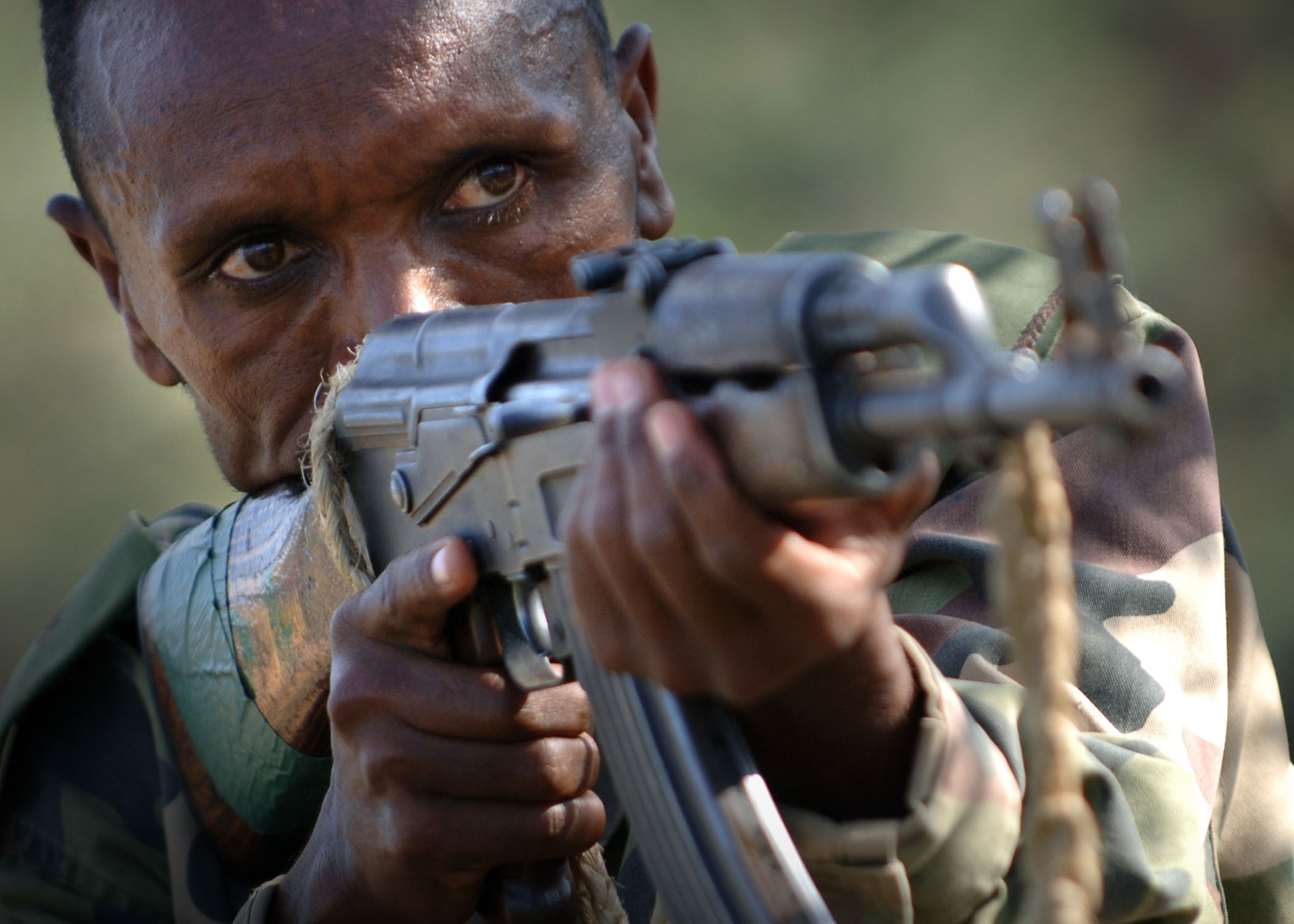
Ethiopian national defence force soldier with AK-47 assault rifle
Russian military hardware is widely available for sale in the markets of Somaliland and Somalia. In fact, Africa Files estimates that there are 100 million small arms in commission around Africa, the majority around the Horn of Africa. The WFP bought the wheat from Glencore to feed the millions starving in this region.

Even if what UBS claims is untrue, that Russian authorities banned wheat exports for a couple of days in order to artificially inflate its price, and profit margins, then surely Glencore are making "ill-gotten gains" regardless. They are doing so by profiting from war, and the substantial sales raised from their sale of aluminium to arms manufacturers, and by providing the wheat that the WFP buys to feed those displaced by a war that Glencore helps sustain.

This cynical, cyclical supply and demand business model reminds me of the way that the Italian Mafia made a mockery of EU waste management directives a decade ago. In short, mafia-related enterprises monpolised industrial waste management contracts, and illegally dumped toxic residues around the Italy countryside. They then bid for, and won, provincial contracts to clean up the areas that they had polluted. Is this any different to what Glencore are doing?

Selling aluminium to arms manufacturers, and selling wheat to the WFP, is not 'illegal'. Glencore are a 'legal' entity. However, if we consider it right to indict national leaders from Africa on charges of "ill-gotten gains", then equally we have to consider it right to charge leaders of multi-national companies, such as CEO, Ivan Glasenberg, for doing the same.

The International Criminal Court (ICC) regularly seeks to prosecute Africans on war crimes charges, yet has not pursued one western political or military leader on similar grounds, despite the wealth of abuses suffered the world over. The African public are wary of the ICC, distrustful of what they see as a white-man's version of justice.

Despite these well-intentioned indictments, will Africa come to see this case as reaffirmation of human rights colonialism when we abjectly fail to charge the likes of Glencore on the same grounds?

A final word on the WFP. If the WFP are not politically aware enough to know that the likes of Glencore are heavily involved in the war machinery, an act that the WFP consider leads to hunger and starvation, or even know of their dealings in the U.N. Oil For Food scandal, then they have little hope of ensuring that the future national governments in the Horn of Africa will reduce hunger.

A strategy that benefits war profiteers only teaches future leaders to act as they already do.

Wednesday, 8 February 2012

Glencore, Africa, & the World Food Programme: Ill-gotten gains and food security (part 1)


Every gun that is made, every warship launched, every rocket fired signifies, in the final sense, a theft from those who hunger and are not fed, those who are cold and are not clothed.
Former U.S. President Dwight D. Eisenhower, 'The Chance for Peace',16 April 1953
President Teodoro Obiang
The Guardian has reported that French authorities are impounding the assets of three serving African leaders and their families, in a case known as "ill-gotten gains". Those accused include Omar Bongo and his son, Ali Bongo from Gabon, the Congo-Brazzaville leader, Denis Sassou-Nguesso, and the Equatorial Guinean President, Teodoro Obiang and his son, Teodorin Obiang.

When balanced against their supposed state salaries, the assets that each of these clans had accrued over their years in power leaves left many questions unanswered. Hence, this legal action, initiated by anti-corruption NGOs. My initial reaction was one of satisfaction; the powerful should be held to account for their actions.

The tail end of this piece notes that NGOs are unable to bring corruption cases against African leaders in the UK, despite London allegedly being the "No. 1 destination for kelptocrats", according to Tim Daniel, a British Lawyer and anti-corruption expert. It is up to our authorities to do so.

In the UK, we have charged James Ibori, a former governor from the Delta state of Nigeria, with corruption. This region has a wealth of oil and natural reserves, and it has become synonymous with corruption, as money and power intermingle in a tale of filthy lucre populated by sly "Lucans".

In their book, 'Where vultures feast', Ike Okonta and Oronto Douglas, wrote that the IMF could not account for 150,000 barrels of oil that was being produced daily, the implication being that former Nigerian dictator, General Sani Abacha, and his cohorts were siphoning off the proceeds.

Six months later, Abacha completely redrew the allocation of crude oil contracts, handing a third of future supplies to Glencore, who later gained greater control of the Nigerian crude industry.

Later in the Congo, The Australian reports:
The breakthrough came in 2005, when Elliott detectives discovered that two consignments of Congo oil had been loaded on to a vessel called the Nordic Hawk for sale to Glencore, a British company set up by Marc Rich, the Swiss-based trader. 
Glencore intended to sell the oil on to BP in what should have appeared as a normal industry transaction. 
Kensington promptly applied to the High Court in London for injunctions to seize the proceeds of the Nordic Hawk consignments on the grounds that they were fraudulently concealed sales by the Brazzaville Government... 
...Somewhere along the way, millions of dollars went missing, and the judge noted that an examination of the bank statements of one of Gokana's companies "reveals that there was virtually no connection between the cash passing through its bank accounts and the sums it should have received for the oil it sold". 
Where the money went remains a mystery.
Glencore's website reveals that they also have operations in Equitarial Guinea. As part of its E&P portfolio, they have operated under the guise of Noble Energy, along with other oil giants, with the agreement of, and help from, the U.S. government. Yesterday, Glencore were due to merge with Xstrata to form one of the largest companies in the world.

Is it a coincidence that Abacha and Sassou-Nguesso were dealing with Glencore at about the same time that they were said to have been misappropriating resources and funds? Is it a coincidence that Glencore's name is linked to all the geographical areas ruled by those charged in France? 

Saddam Hussein on trial July 2004
Beyond this, Glencore have a history of dubious corporate activity. It was reported that the CIA believed that Glencore did business with Saddam Hussein and that they received millions in illegal kickbacks during the U.N. Oil For Food programme. Reuters refer to human rights and environmental abuses in Colombia, and pollution-related health problems in Zambia. This does not includes a number of other abuses that they have been associated with in Australia, Colombia and Kazakhstan, as detailed by Donal O'Driscoll for Saving Iceland.

Furthermore, this behemoth has strong political ties. For example, Glencore owns 8.75% of United Company (UC) Rusal Limited. Chaired by Oleg Deripaska, through his En+ group, and co-chaired by Nathanial Rothschild, who runs Vallar which has a 40% stake in Glencore, both are friends of former EU Trade Commissioner, Peter Mandelson, and UK Chancellor, George Osborne. Wikileaks reveals that Deripaska has Vladimir Putin's ear.

This is what the 1% have and do. More than bonuses, more than tax breaks, they have the political and economic power to do as they please, harming whoever gets in their way.