Justitia, Old Bridge of Heidelberg

Justitia, Old Bridge of Heidelberg
Justitia, Old Bridge of Heidelberg © Gernot Keller, 2007
Blinkered Justice articles also appear on CrimeTalk and Government In The Lab

Friday, 27 April 2012

Does Charles Taylor's guilty verdict signal the end of impunity?


(c) Galehr [CC-BY-3.0] via Wikimedia Commons 
No.

Although that is not what the UK media would have us believe today. The likes of The Independent and The Telegraph have written lead articles suggesting that all leaders can be held accountable for their crimes by the International Criminal Court (ICC). The Independent froths:
Of even greater significance, however, is the milestone the case marks in the effort to ensure that even the most powerful individuals may be held to account under international law. As the first conviction of a former head of state since the Nuremberg trials, Taylor's sentence sends the clear signal that even those in the highest positions are not untouchable.
So who might these most powerful individuals be? If we are talking about leaders of nation states, then we should look immediately at the the leaders of the United Nations Security Council; the Presidents of the USA, France and Russia, the Prime Minister of the UK, and the Premier of China.

Yet three of these leaders would face no sanction under international criminal law because they are not party to the Rome Statute that governs the ICC. The USA, Russia and China have not ratified the statute, and so are immune to any charges brought against their elites.

The likes of Presidents Bush, Putin, and Hu will never face criminal sanctions for their roles (aiding and abetting) war crimes, crimes against humanity and genocide in Iraq, Afghanistan, Chechnya and Tibet to name but a few. Whilst the UK is a party to the ICC, how likely is it that we will see former Prime Minister Tony Blair, and his Ministers, such as Jack Straw, brought to justice for their complicities in Iraqi and Libyan abuses?

The Independent conclude:
But so comparatively new, and awesomely complex, an endeavour as the establishment of international criminal procedures was never going to be easy. For all the criticisms and caveats, the most important point is still that the so-called Big Men who have held sway in Africa – and in the Balkans and the Middle East – for so many decades have witnessed an hour of reckoning at last. No longer can they rest easy in the comfortable assumption they may do as they please, however atrocious, without fear of the consequences. Position and power place no warlord above the law. With the conviction of Taylor, the days of impunity are over.
(c) Strassengalerie [CC-BY-SA-3.0], via Wikimedia Commons
We see the court, and perhaps the court sees itself, as being responsible for prosecuting those easily identified as “monsters” or “bogey men”; we change the language from “leaders” or “heads of state” to “warlords” or “dictators”. They come from places that are understood as being “troublesome” or “failed states”. Just as with our domestic criminal justice systems, our eyes averted from the crimes of the powerful.

This is a thorny issue for Africa, as the ICC predominantly prosecute African leaders without taking any action against more powerful Western leaders. Afua Hirsch's blog, and the comments on it, further demonstrate the distrust with which this Westernised legal structure is perceived.

Unlike our domestic criminal justice systems, which have the power to hold public officials to account (regardless of how often they pursue a charge), the ICC has no authority to hold the more powerful state officials to account at the international level. As long as the more powerful countries are able to elude the long arm of the law, any justice can not be free from political interference.

Consequently, it does not signal the end of impunity. 

Enhanced by Zemanta

Tuesday, 24 April 2012

Desistance and recidivism: the Sky News and Jordanian government model


It seems that Sky News and the Jordanian government have alerted us to new strategies in the fight against recidivism and desistance. It is so brilliant and simple, and I wonder why the criminal justice system has not adopted it wholesale before now. 


No need to ponder whether community-based punishments or prison programmes are best at reducing re-offending rates. The answer is simple; listen to those who are guilty of former crimes (i.e. phone hacking, torture) say they will not commit these, or other, crimes again, and accept it.  


Well, that is more or less what Head of News at Sky News, John Ryley told the Leveson inquiry yesterday (above). He thinks "it is highly unlikely in the future that Sky will consider breaking the law". When pressed further on his lack of overt support for the law, he added that he was "pretty much ruling it out". Now imagine if someone who burgled houses for a living responded in a similar manner in a court of law. 

Whilst I note that Ofcom have started an investigation into Sky's admission of two counts of email hacking, let us not forget that this is a criminal, not civil, offence. Sky News have fallen foul of the Computer Misuse Act 1990 and the Regulation of Investigatory Powers Act 2000


Using honesty as a tool to divert any guilt, Ryley admits that he was not as aware of these Acts as he should have been. Given that he will have been aware of Clive Goodman and Glenn Mulcaire's criminal activities, surely Ryley, obviously not an unintelligent man, could have then made the fairly obvious connection between phone hacking and email hacking. 


Falun Gong practitioner tortured by guards in a labour camp in China
(c) Asdf12345
Similarly, the UK government has accepted that the government of Jordan will not use evidence obtained through torture in any case against Abu Qatada. Yet Jordan regularly tortures and detains people based on evidence gained through torture. The latest Human Rights Watch report states:

Perpetrators of torture enjoy near-total impunity. The redress process begins with a deficient complaint mechanism, continues with lackluster investigations and prosecutions, and ends in police court, where two of three judges are police-appointed police officers. 

Would the UK government accept similar reassurances from China if it was returning a an illegal immigrant Falun Gong practitioner? Regardless of the innocence or guilt of the fictional Falun Gong practitioner, if the UK is truly a civilised society and a respected guardian of global human rights, we should not be returning anyone to face a trial overseas where torture and abuse of  human rights is so intrinsically linked to justice.


We try and detain illegal immigrants for crimes committed in the UK. We have the means to try Qatada here. We choose not to. 


Wednesday, 11 April 2012

Here we are now, integrate us: England's integration strategy


Currently on a short break. I will return in full next week, but will try and tweet in the next few days. Found this little piece which I had prepared a few weeks ago hidden under the cyber carpet. Hope you all well.

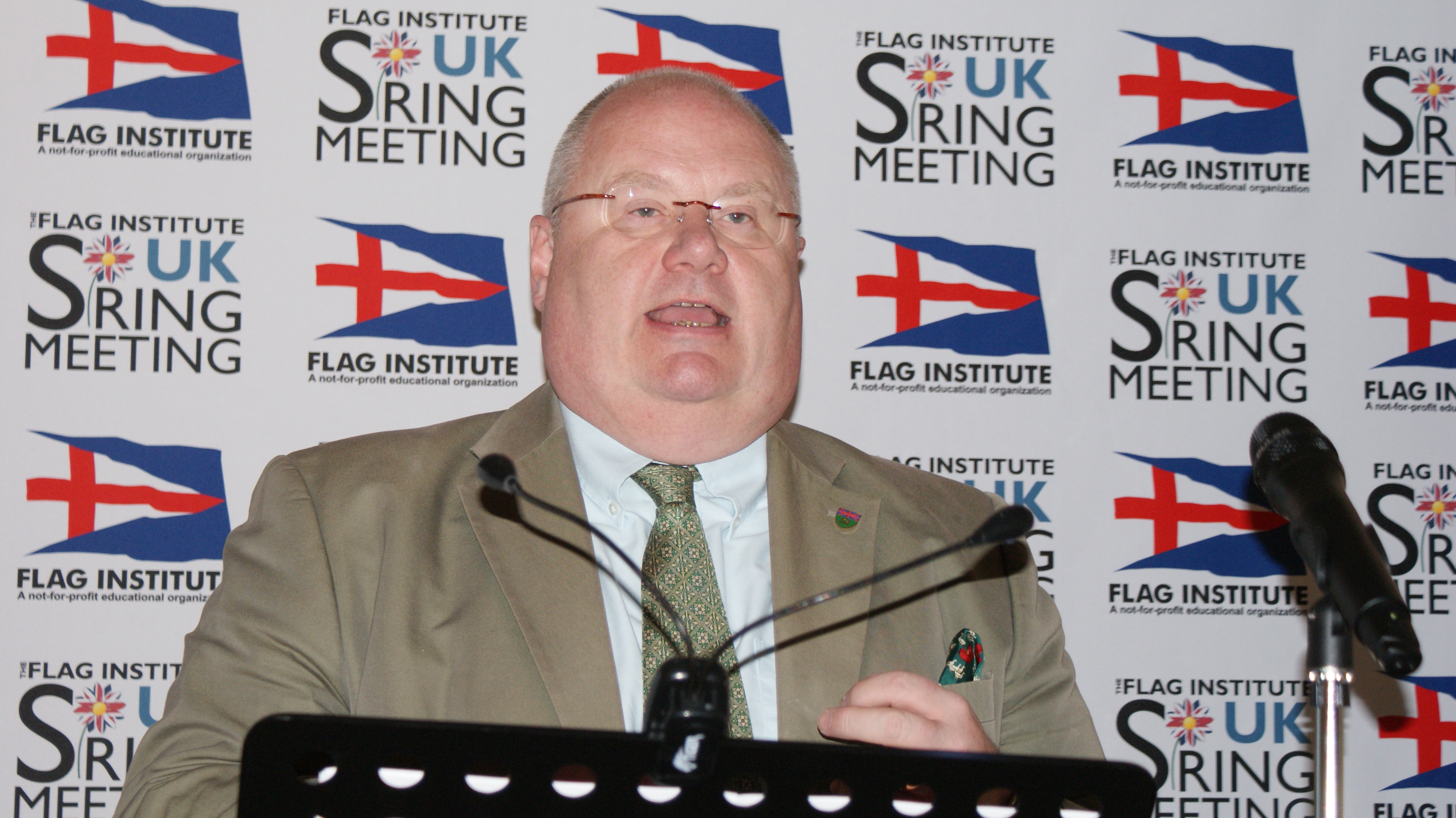
Eric Pickles delivering keynote address at Flag Institute 2011
(c) Charles Ashburner [CC-BY-SA-3.0]
A few weeks ago, Eric Pickles, the Minister for the Department for Communities and Local Government (DCLG) unveiled the government's integration strategy, which plan to help create an harmonious England, free of discord and hatred.

The idea is that in an integrated society, everyone can play a full part in the every day workings of life nationally and locally. The UK government believes that there are 5 key themes on which an integrated society can be built: social mobility, participation, responsibility, common ground, and tackling extremism and intolerance.

Despite using several of these same themes, multiculturalism is seen to have failed, with the sense that we now live in a more divided society. The 2011 summer riots, and the perceived threat from Islamic extremists inform this strategy, with risk, fear and security pervading its discourse. As such, the government considers that something needs be done:
We should be robustly promoting British values such as democracy, rule of law, equality of opportunity and treatment, freedom of speech and the rights of all men and women to live free from persecution of any kind. It is these values which make it possible for people to live and work together, to bridge boundaries between communities and to play a full role in society. When this is underpinned both by opportunities to succeed, and a strong sense of personal and social responsibility to the society which has made success possible, the result is a strong society.
The use of “British values” in this context is used to represent a nation that is civilised, Christian and white. The same values that informed a colonial Empire, raiding Africa and Asia for her resources. Why is it that “British values” are different to, or better than, other nation's values?

The strategy is predominantly aimed at a young, male, disadvantaged Muslim/White audience. In a society that has “welcomed” migrants from all over the world, English identity, and values, may well have changed, through personal and professional partnerships, and through other cultural influences, such as music, film and food.

Disability protest poster (c) Byzantine_K
As evidence that their targeted audience is the right one, DCLG refer to their own, commissioned reports, and the Equality and Human Rights Commission's Triennual Review (2010). “How fair is Britain” notes that women and the disabled experience social exclusion, certainly in the guise of a lack of being able to participate and intolerance. Yet, there is nothing for them in this integration strategy.

Is this because the UK government considers that both groups have integrated? If so, why would the government consider that its key factors might work for its target audience, when women and the disabled still feel excluded?

It is in the shift from 'the national' to 'the local', that the government believes that cultural nirvana can be attained. DCLG notes that local communities have long come together to address civil problems, and it is drawing on this social capital to resolve our divided society. However, it accepts that it has to provide a national framework to make it work, utilising the production of civic leadership on integration, with locally-led partnerships driving it forward thanks to cross-Whitehall liaison and assistance.

Even in this basic approach, there are anomalies. For example, whilst the government talk of civic leadership and creating “the space for an open and honest debate”, it recently closed the door to a number of health-industry leaders' involvement in discussions on the localisation of health services. This undermines participation.

Although each of the 5 factors mentioned above appear distinct from each other, they overlap and intertwine, just as ideas of the local and national do.

DCLG propose encouraging young people to develop their sense of responsibility and self-management, through volunteering and a National Citizens Service. Deemed to be participating in their local communities, DCLG will ensure that “people can trust public bodies”, such as those who can enable them to find work locally. Yet when these public bodies face charges of fraud and corruption, it is difficult to see how this might work. More so, when the state fails to rescind its central contract.

In terms of localities leading the way in economic regeneration, and thereby creating social mobility and tackling extremism, DCLG have failed to explain how this might come about. Whilst speaking English is assumed to enable social mobility and a sense of common ground, it ignores those migrant businesses, such as Chinese restaurants, that use the same language and cultural references. Their chefs may not speak English, and depending on your understanding of local, few would argue they have not integrated into their local areas.

Chinatown, London - local integrated community? (c) Aurelien Guichard
The additional language requirement for people to be able to speak English before they settle here is surely a bid to appease a supposed silent majority who baulk at immigrants not speaking English. In any case, it is difficult to see how this might happen, given that the rules for entry into England also concern the rest of the UK.

So how does 'local' England integrate with their (inter)national partners overseas? Within the EU, and the UK, it has not adopted the Euro, and it has not come on board with Schengen. We veto EU moves to regulate the financial markets that helped cause the recent crises. Cynics might argue that the UK has sought to take without giving, seeing its own rights and responsibilities in an international arena quite differently to how it views its “problem people” acting out theirs.

To close, DCLG make the following point in their strategy:
People come together through day-to-day activities, not 'integration projects' which too often feel irrelevant and prove unsustainable.
Quite.