|
| (c) Holger Ellgaard |
I
am republishing the following article as found
on openDemocracy.
It was written by John Grayson, who works with the South
Yorkshire Migration and Asylum Action Group. The article
discusses the contract won by G4S to house asylum seekers/refugees (having beaten beaten Sheffield City Council to it on costs), and of
his frustrations with local MPs and various asylum charities who
have failed to speak out against the G4S takeover.
G4S
have a chequered history. They were implicated in the deaths of Jimmy
Mubenga and Eliud
Nyenze, they provide
services to illegal settlements in the West Bank, and are accused
of overworking and underpaying their staff, to name but a few of
their crimes. As John points out in his conclusion, we should be concerned about G4S's (militaristic?) expansion into the
criminal justice system, and the effects that this will have for all
detainees who become nothing more than commodities and assets on the
G4S balance sheet.
G4S turns a profit in “asylum markets”: who's speaking out and whose lips are sealed?
The
vast private sector security company, G4S, feared and distrusted by
asylum seekers, is about to be awarded contracts to run asylum seeker
housing throughout the North East, Yorkshire and Humberside. Last
Friday a group of asylum seekers’ advocates and academics met with
government and company representatives to explain why this is a
thoroughly bad idea.
That
the meeting happened at all was some kind of victory for the South
Yorkshire Migration and Asylum Action Group (SYMAAG), of which I am a
member, for local
people who protested outside the UK Border Agency’s Sheffield
offices ↑ on
15 February, and for 28 outraged academics from Yorkshire
universities whose protest letter was published in the Yorkshire
Post ↑ .
The academics — researchers and university teachers in the
fields of housing and immigration in the Yorkshire region — cited
the death of Jimmy Mubenga in G4S’s care, and the 773 complaints
lodged against G4S in 2010 by detainees including 48 claims of
assault, and said:
“Asylum seeker tenants already feel intimidated and threatened by the prospect of prison guard companies being installed as their managing landlords.”
Soon
after the 15 February protest, the UK Border Agency declined to speak
with us, saying the contracts were as good as done. Then they
appeared to change tack, agreeing to meet with us at a Sheffield
refugee centre on Friday afternoon (24 February). The people they
sent were not procurement or due diligence experts but serving
members of UKBA Local Immigration Teams (one in full uniform) who had
been working closely with G4S apparently in the period since last
December when preferred bidders were announced.
It
emerged during the meeting that since December 2011 a project called
COMPASS TRANSITION UKBA, scheduled to begin after contracts
were signed, had been actively cooperating with G4S to ‘minimise’
the effects of evicting potentially 900 asylum seeker occupants of
local authority housing in Yorkshire. They had not been scrutinising
the costings or human rights risks or, as UKBA claimed, working to
“ensure that there are no material risks” with the contracts.
They had not, it emerged, bothered to check on the impacts on asylum
seeker families and children’s human rights, on education and
health by referring the contract to Local Safeguarding Children
Boards (LSCBs) who have statutory responsibility for impact
assessments of public sector of contracts this kind.
In
the meeting G4S switched from its denials of being a “prison guard
company” (as we had described them in the Yorkshire Post), to now
claiming that G4S was developing a specialist and very separate
housing division to take on asylum seeker housing as part of its
interest in “asylum markets”.
This
reinforces the view already held by some analysts that it is G4S’s
intention to continue expanding its management of the prisons,
criminal justice and immigration ‘estates’, while managing a
housing contract (with effectively no legal rights for tenants), and
to use this dubious base to expand into the wider privatised housing
market. Housing academics and voluntary sector organisations amongst
the campaigners have made clear to G4S their distaste for this
enterprise, rooted as they are in traditions of public and charitable
housing provision with statutory rights for tenants as both customers
and citizens.
The
meeting clearly demonstrated that a G4S takeover meant the end of
sixty years of government and council funded humanitarian housing in
South and West Yorkshire boroughs for vulnerable individuals fleeing
torture and persecution and applying for asylum in the UK under
international treaties.
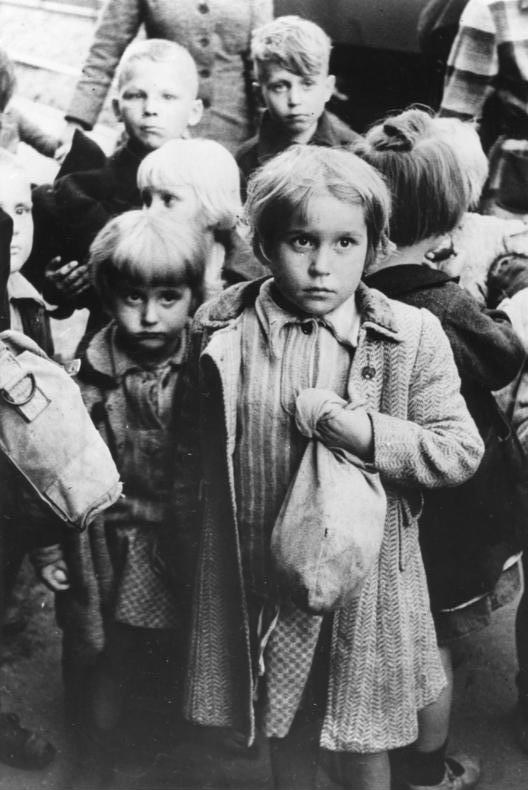 |
| Repatriation of German children after WWII - source German Federal Archive |
Sheffield
City Council was the first ‘City of Sanctuary’ and still embraces
the label. The Council certainly did not want to get rid of asylum
housing which at present serves 60 per cent of local asylum seekers –
they were simply outbid on ‘cost’. When local Sheffield asylum
rights organisations presented a petition opposing the G4S takeover
at the city Council meeting on 1st of February the whole council
applauded.
Councillors
and campaigners understand that the G4S contract not only privatises
this humanitarian function but destroys it and replaces it with the
clear message adopted by both Labour and the Coalition that asylum
seekers are not welcome here, indeed they should be treated like
criminals with prison guards as their landlords, as part of
deliberate policy of deterrence. As one Zimbabwean asylum seeker in
Sheffield declared, “I do not want a prison guard as my landlord.”
Besides
the Yorkshire
Post we’ve
had positive coverage on Sheffield local radio, Big
Issue in the North and
the Barnsley
Chronicle.
There’s been little interest from the mainstream national media,
although the Independent ↑ reported
on our public letter, which also featured in Socialist
Worker ↑ . OurKingdom and
the Institute
of Race Relations ↑ have
published our journalism, we have a growing social media presence,
and a newly established website ↑ .
But
for all our awareness-raising, some people you might expect to care
don’t seem too bothered. In Sheffield, after Liberal Democrat local
councillors helped to get a petition before the city council
supporting the campaign, deputy Prime Minister Nick Clegg, a local
MP, wrote to immigration minister Damien Green on 3 February and is
apparently still waiting for a reply.
Labour
politicians in South Yorkshire have not even responded to e-mails
from their own constituents about the matter. In Barnsley, where
shadow culture minister and ex-SAS hero Dan Jarvis has his seat
alongside shadow Cabinet minister Michael Dugher, there has been
absolutely no response.
As
the campaign has spread the picture is little different. Across in
Hull, campaigners lobbying Labour MP Diana Johnson to intervene
before contracts were signed at the end of February, were advised by
Ms Johnson to go away and get an e-petition with 100,000 signatures
so that there could be a debate in Parliament.
Two
Labour politicians have responded with positive action. John
McDonnell promised to raise the matter in Parliament. Crucially,
perhaps, the Rt Hon David Winnick MP has asked for a detailed
research report from the campaign to be sent to members of the
Parliamentary Home Affairs Select Committee on Friday 24th of
February which only two weeks ago published
a report strongly critical of G4S ↑ .
Whilst
campaigners are astonished at how far we have come in very little
time, we’re disappointed about the apparent lack of advocacy for
asylum seekers that we’ve encountered in some surprising places.
Refugee Action’s sole contribution was referring us to its chief
executive’s statement ↑ about
his ‘concerns’ on its otherwise campaign-free website.
 |
| Distributing food aid in Congo refugee camp (c) Julien Harneis |
Refugee
Action receives funding under UKBA’s voluntary returns programme,
with volunteers at Vulcan House, UKBA’s regional headquarters in
Sheffield, handing out leaflets to asylum seekers fleeing
persecution, suggesting that they return ‘home’. The Refugee
Council website search facility cannot locate a reference to G4S and
the campaign, the Council of course eschews ‘politics’ and
receives (much reduced) government funding.
Other
asylum charities, funded through subcontracting for companies like
international security company Serco, avoided the campaign. Some
voluntary organisations and local authorities have been negotiating
for work with G4S before contracts have been signed. Others have
negotiated to reduce the impacts of the takeover — but
they have still failed to voice support for the campaign.
The
Yorkshire grass roots charities, refugee and asylum seeker groups,
church groups, political networks and campaigners are much more vocal
in their opposition to G4S and possible threats to the human rights
of asylum families. In Sheffield the Children’s Society in South
Yorkshire’s Embrace Project (supported by the national Society) is
backing a submission to the Sheffield Safeguarding Children Board
(SSCB) to demand that UKBA does a thorough children’s rights
assessment of the contract.
In
Barnsley local council officers are publicly backing a similar
approach. In Kirklees the Local Safeguarding Children Board approach
is spearheaded by Huddersfield University’s Applied Childhood
Studies Department. In Bradford
and Kirklees ↑campaigners
are now active and the human rights organisation Just West Yorkshire
is reporting the issues.